This was the biggest year of running I’ve ever had.
More kilometres than ever before, personal bests at almost every distance, and — most importantly — a level of consistency I’ve never achieved before.
This didn’t come out of nowhere. It was built on previous years of training and a growing base of “lifetime mileage” fitness, which finally allowed me to run more, run faster, and recover better — without injury.
This post is a look back at the year that was, and a look ahead at what comes next.
The Numbers — What the Year Actually Looked Like
By the end of the year, the totals looked like this:
- Total distance: 2,606.8 km
- Total runs: 228
- Time on feet: 229 hours, 10 minutes
- Elevation gain: 6,224 m
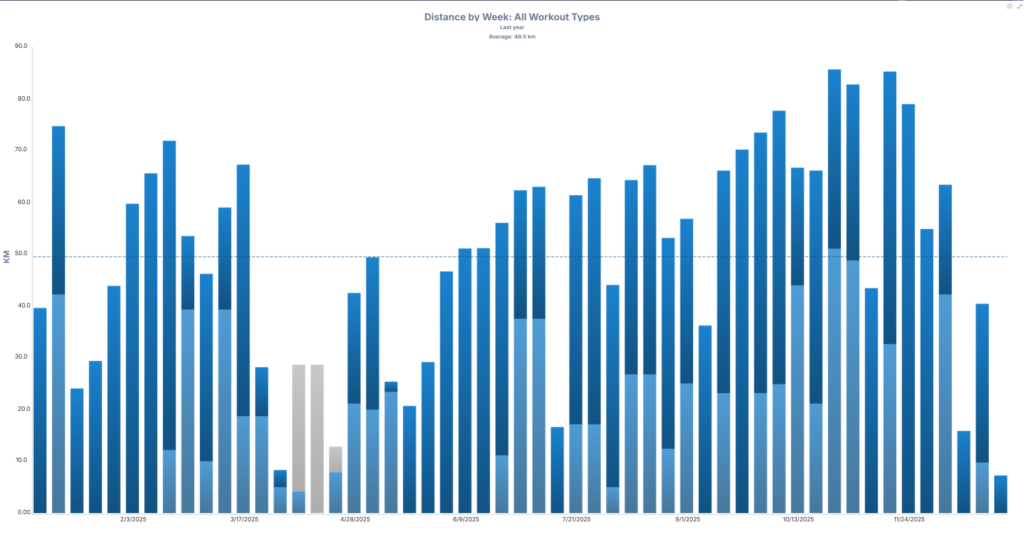
That averages out to 50 km per week, sustained across an entire calendar year — almost exactly the distance goal I set at the start of the year.
Compared to previous years, the elevation gain was deliberately modest. Flatter, repeatable routes meant better recovery, fewer disruptions, more focus on quality sessions, and the ability to run straight out the front door — minimising time away from home.
Compared to Previous Years
2025
228 runs · 2,606.8 km · 229 h · 6,224 m
2023
200 runs · 2,402.5 km · 254 h · 20,107 m
2024
192 runs · 2,276.4 km · 224 h · 11,357 m
2025 was faster, smoother, and required less intensity than previous years. It was a controlled build toward more distance and more usable fitness. Even with an unplanned gap earlier in the year, I still hit my target.
Race Recap — One Race at a Time
January — Starting Fast
The year kicked off on January 1st at parkrun, West Beach. I ran 20:24, a 5 km personal best, capitalising on peak marathon fitness.
Less than two weeks later, I ran my second marathon, finishing in 3:25 — a huge PB, cutting more than 30 minutes off my previous best. Eight years after my first marathon, I returned to the same course in Khon Kaen. It wasn’t perfect, but it was decisive.
March — Speed Builds
In March, I raced the Vientiane International Half Marathon (10 km) in 41:55, a lifetime best.
Still riding marathon fitness, this was meant to be a sharpener as part of a half marathon build — a sign that speed hadn’t been lost in the longer work.
April–May — Illness and a Busy Race Calendar
Sustained illness stopped me running entirely for several weeks. My return came at the KIS 5 km, where I ran 21:16 — a clear indication of how much fitness I’d lost.
Only a week later, I ran Bangkok 21 parkrun in 1:44. Completely underdone, in the sauna that is Bangkok in May, it was a slog — and one of those races where you can’t help but wonder what might have been.
The travel and racing continued at Bang Saen 10 km, where I finished in 46:06. Still rebuilding, humbled by the hills I ended up walking.
August — Breaking Through
At the Constitution Day 5 km Fun Run, I finally broke a long-standing barrier, running 19:50 — my first time under 20 minutes.
The rebuild was properly underway. Consistency had me back on track.
September — Strength Over Speed
In September, I ran the Chiang Khan Super Half Marathon (25 km) in 2:08, finishing 1st overall in the Men’s 30–39 category.
A race won through patience and strength rather than speed.
October — Incremental Progress
A modest PB at the Luang Prabang Half Marathon, though still not quite in the shape I’d been tracking toward back in March.
December — Closing the Loop
I closed the year at the Vientiane International Marathon, running 3:18:59 — shaving more minutes off the marathon PB set earlier in the year.
Solid execution on the day. Again, incremental rather than spectacular — but progress nonetheless.
Personal Bests — Then vs Now
| Distance | End of 2024 | Current | Improvement |
|---|---|---|---|
| 5 km | 20:45 | 19:50 | −55 sec |
| 10 km | 42:20 | 41:55 | −25 sec |
| Half Marathon | 1:34:14 | 1:32:06 | −2:08 |
| Marathon | 3:58:54 | 3:18:59 | −39:55 |
The improvements weren’t isolated. Speed didn’t come at the expense of endurance, and endurance didn’t blunt speed. The fitness rose together.
Shoes — What Actually Did the Work
Race shoe: New Balance SuperComp Elite v4
By the end of the year, I was onto my third pair.
What made these work was versatility. They doubled as a tempo shoe, meaning older pairs became workout shoes while a fresh pair stayed ready for race day. They aren’t overly aggressive, so I can warm up and cool down in them without mid-run shoe changes.
They weren’t precious. They were usable. These were the workhorses of 2025.
Daily trainer: New Balance 880
All easy running went through the 880s. Stable, predictable, not overly soft. I like less shoe for easy running — sinking into overly soft shoes tends to aggravate my hips.
My third pair of the year is nearly done after around 450 km.
Some Statistics — A Quick Snapshot
- 2,606.8 km
- 228 runs
- 229 hours on feet
- 6,224 m climbed
- ~50 km/week
- 4–5 runs/week
- ~11.4 km per run
- 5-second peak HR: 193 bpm
Key theme: consistency > intensity
The Six-Month Block That Changed Everything
I didn’t enjoy the feeling of walking in a race I’d run before at Bang Saen — hundreds of people streaming past. That moment mattered.
It pushed me into the most important stretch of the year, running from June 3rd through to the marathon on December 14th.
Across those six months, I committed to a simple rule: run five days a week.
During that entire period, I missed just five runs.
No hero workouts. No ripping the last rep. No squeezing pace into easy runs. Just showing up — rain or heat (or both) — and training today so I could train again tomorrow.
Fitness compounded through consistency.
Looking Ahead — 2026
If 2025 was about consistency, 2026 is about a little more of the same.
The next couple of months are about speed — 5 km training and racing, sharpening the top end that now sits on a much bigger aerobic base. I’ve got some long-standing PBs at shorter distances that look ripe in my current shape. I’d like to spend some time on the track.
From there, the focus shifts to the Vientiane International Half Marathon, with the goal of going very close to 1:30 — and possibly under.
March through June brings heat and smoke, so the plan needs to adapt rather than fight conditions. That likely means 45–50 minute treadmill sessions in the morning before work, five days a week (maybe six) — something that starts to resemble a Norwegian Singles–style approach.
Once conditions ease, the longer work returns. Another half marathon or one of the tougher 25–30 km races around September makes sense.
Beyond that, marathon planning starts to orbit 2027, potentially something in Japan depending on timing. Working backwards from that may still leave room for another marathon in November or December in Laos or Thailand.
3,000 km is the goal for 2026.
Strength. Durability. Progress.