3:18:59 | 7th Overall | 2nd Age Group | PB
Since my last marathon back in January, the trajectory has been clear — even if the path hasn’t been perfectly smooth.
There have been PBs at every distance along the way: 5 km, 10 km, and the half marathon. An age-group win at Chiang Khan. A lot of quiet confidence built one session at a time.
There was a hiccup in April — illness that knocked me out for nearly a month — and for a while it felt like the year might unravel. But once I got moving again, the keyword became consistency. Five days a week, week after week, with only a handful of missed runs across the entire build.
That consistency added up to kilometres — quite a lot of them. Early mornings. Long runs in the heat and humidity of Vientiane, grinding sessions, running the loneliest parts of the marathon route in the dark, learning every undulation along the way before race day arrived.
I’d set my goals around pace. I had a number in my head, and with it came expectations. In hindsight, that was the wrong mindset. The marathon — and your physiology — doesn’t care about your time goals. The weather certainly doesn’t.
What matters is running a well-controlled effort and making good decisions for as long as possible. Do that, and the time will take care of itself — especially in the marathon.
Today was the day all of that got tested.
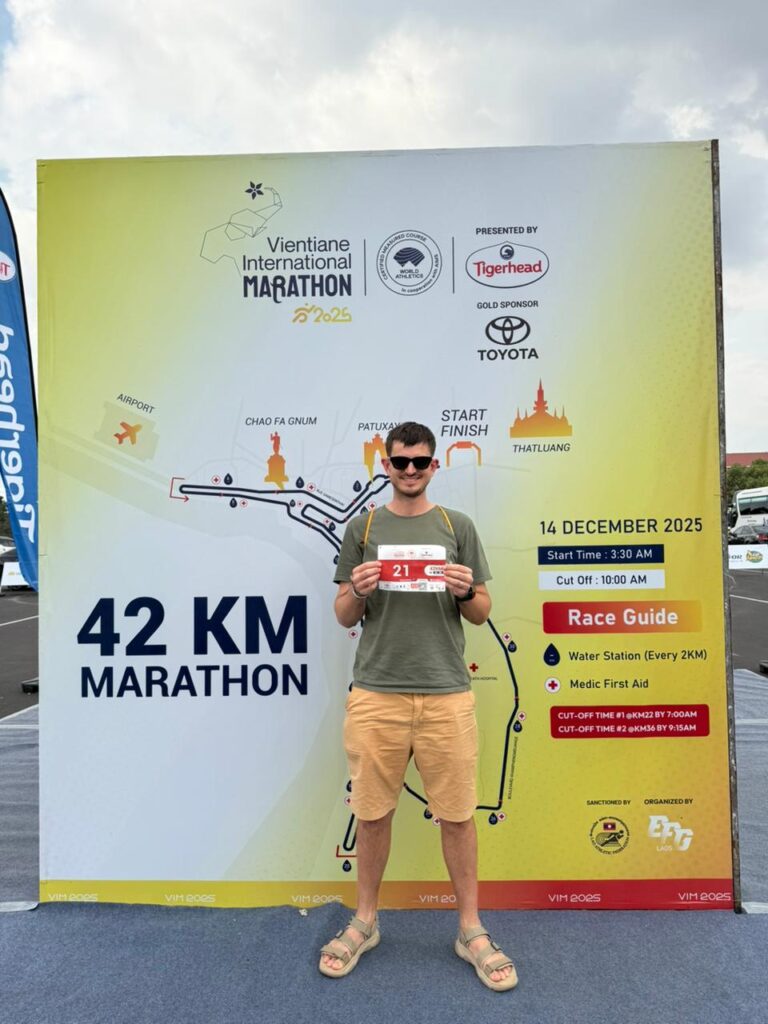
The alarm went off at 2:00 a.m.
Overnight oats, coffee, electrolytes. Nothing fancy. By 2:45 a.m., we were in the car heading to the start, the city quiet and damp after overnight rain.
Conditions were okay, but far from ideal: around 21°C, roughly 80% humidity, and wet roads. It felt marginally cooler just before sunrise, but not by much. Runnable, but never comfortable.
I did a short warm-up with a couple of faster segments. The first 100 metres was way too fast (about 3:30/km), which was a good reminder to calm things down. Then a minute at around 4:30/km, round off to about 1.2 kilometres to get the heart rate going.
At the start line there were familiar faces and a bit of chat. No fanfare. somehwat suddenly, the count down — 5, 4, 3, 2, 1 — and we were off, slightly earlier than expected.
The course drops downhill immediately and I went out too fast. The watch flashed 4:15–4:20/km in the opening few hundred metres. I briefly found myself in the 3-hour pack, but quickly let them go.
I settled into 4:30s, running with a small pack down the main drag. Heart rate was already creeping into the mid-160s, not ideal this early. After a couple of kilometres running with a guy from Denmark, I eased away and found myself mostly running solo.
The first out-and-back went toward the airport. I saw the leaders coming the other way these days im always somewhat surpirsed to find myself not that far behind, on the return leg I picked up a few cheers from people I knew. Fueling plan was gels every 5 km.
Pace sat mostly between 4:38–4:42/km, but it felt like work. When we turned around, it became obvious we’d had a slight tailwind on the way out. The run back — roughly km 8 to 14 — was into a headwind and the pace drifted closer to 4:40/km.
Once we hit the river road, things mentally settled. This is my regular training route and it felt familiar. Heart rate was still on the higher end of what i was wanting, so through km 15–18 I eased off slightly, letting the pace sit around 4:41–4:42/km instead of forcing it.
Around 18 km, another runner came up on my shoulder and we ran together for a while. At about 23 km, i stopped to get a rock out of my shoe tread and lost contact.
From about 26 km, I could feel the race changing. Not a blow-up — just the sense that the legs were starting to reach their limit. I could hold pace, but it was taking more effort to do so. Not a good sign this early. One of the guys up ahead pulled off and started walking, the other surged ahead.
The hill at 32 km
The hill at 32 km was the key moment.
I powered up it managing it reasonably well and the pace slowed, but the effort was manageable. I passed another runner who was blowing up on the hill.
The plan was to crest the hill, change gears, and use the downhill to claw back time.
That gear wasn’t there.
I increased effort, but the response never came. Even running downhill felt like hard work with no reward. From that point on, I wasn’t collapsing — I was slowly fading. Still I managed to reel another guy near the EDL building
The numbers tell the story clearly:
I dropped off by 15 seconds from 30-35k and another 31 sec from 35-40k
- First half: ~1:38:39
- Second half: 1:40:20
- Positive split: +1:41 (~1.7%)
Almost all of that fade came late. Between km 35–40, pace averaged about 4:51/km, costing roughly a minute compared to my settled marathon pace.
Traffic and the escort
Around 36 km, I hit heavy traffic from the shorter races — half marathoners and 10 km runners who were already walking. At 40 km, i reached the 5 km turnaround, the road was absolutely packed.
My legs are cooked, weaving through crowds brutal
Around this time i saw another runner up the main drag, one of the guys who’d gone out with the leaders. He was completely cooked, and looked like might tip over sideways, still had a leadout motorcycle clearing the road ahead of him.
I ran him down and took that escort.
With the road clear ahead of me and boost from getting the VIP treatment, I was able to pick up the pace again.:
- Km 41: 4:39
- Km 42: 4:40
- Final 400 m at ~4:20/km
I passed the lead female runner on the final hill and could see the guy I’d run with earlier up ahead. I was closing, but ran out of road. He finished 19 seconds ahead of me.
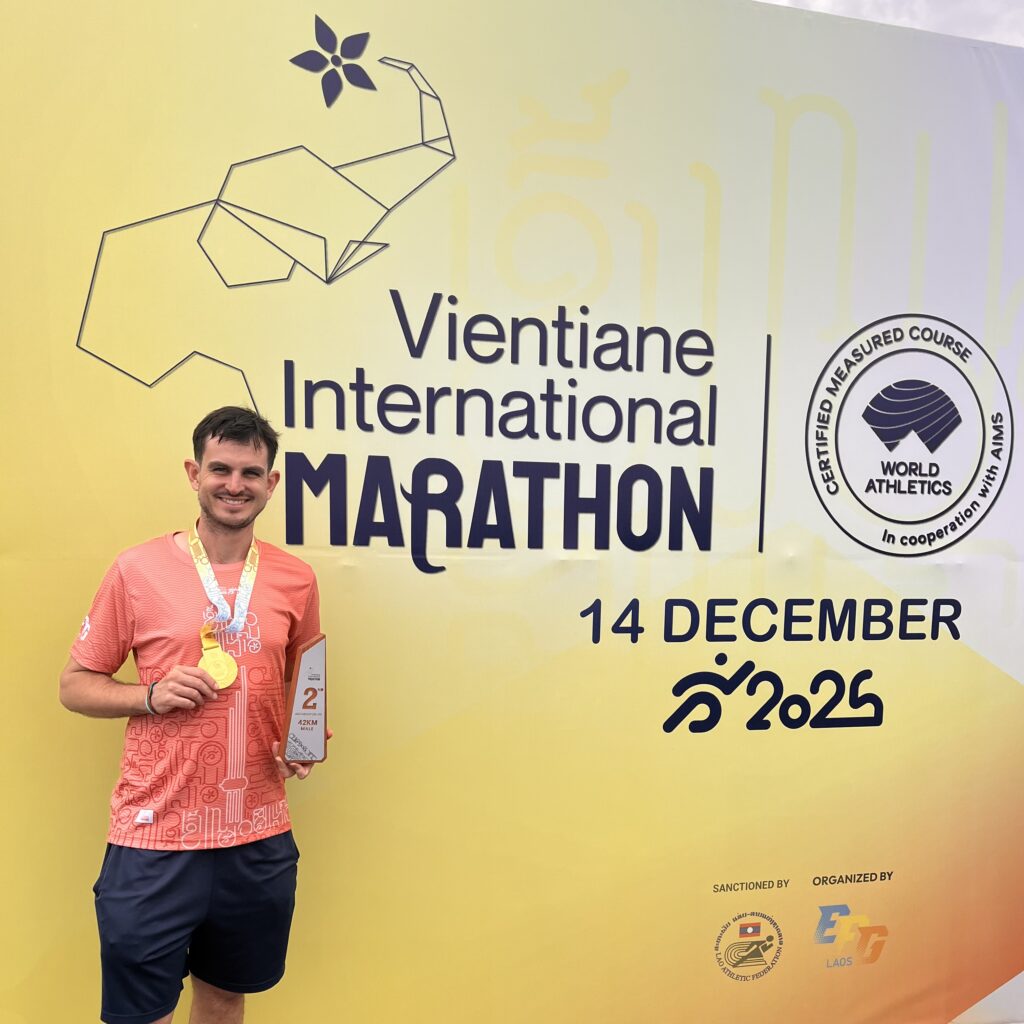
I crossed the line in 3:18:59, good for 7th overall — a new personal best by six minutes and twenty three seconds.
I also finished 2nd in my age group, which came with a solid trophy, 900,000 kip, and a top-50 finishers’ towel — easily the biggest prize money I’ve picked up to date, and enough to almost cover the cost of the gels I went through during the race.
Lessons for next time
Fueling wasn’t the issue. I never felt empty or close to bonking. I did try carrying Gatorade in a soft flask, but one warm sip around 8 km made me feel instantly sick and I didn’t touch it again. Gels plus water worked; warm sports drink didn’t.
Caffeine is one area I’d adjust. I had a coffee pre-race and three caffeine gels, but never felt the buzz I sometimes have in training. More late-race caffeine might help next time.
I also raced in a relatively fresh pair of New Balance SuperComp Elite v4s (about 30 km in them). Late in the race they felt heavy and unresponsive — more like big lumps on my feet, thumping the ground — compared to my older, softer pair. Might be time to explore some different shoe options.
Mechanically, the fatigue pattern was clear. It started in the left calf, then spread into the hamstrings, left glute, and by around 34–35 km, even the lower back was tightening. The aerobic engine was there; the limiter was muscular endurance.
Reflection
Stepping back, this was a good training build and a solid PB.
It’s easy to compare everything to the marathon in January, when I felt like I was in the best shape of my life, but that ignores where the year actually started. I didn’t run at all through April. In May, I ran a 1:44 half marathon. From there to a 3:18 marathon in December is a big jump.
The fundamentals worked. The training was consistent and — importantly — I enjoyed the months of training, maybe even more than the marathon itself.
I didn’t get the negative split I wanted, but I raced all the way to the line and kept moving forward when others were falling apart.
Now it’s about maintaining that consistency and continuing to build fitness. Vientiane Half Marathon in March doesn’t seem very far away at all now.